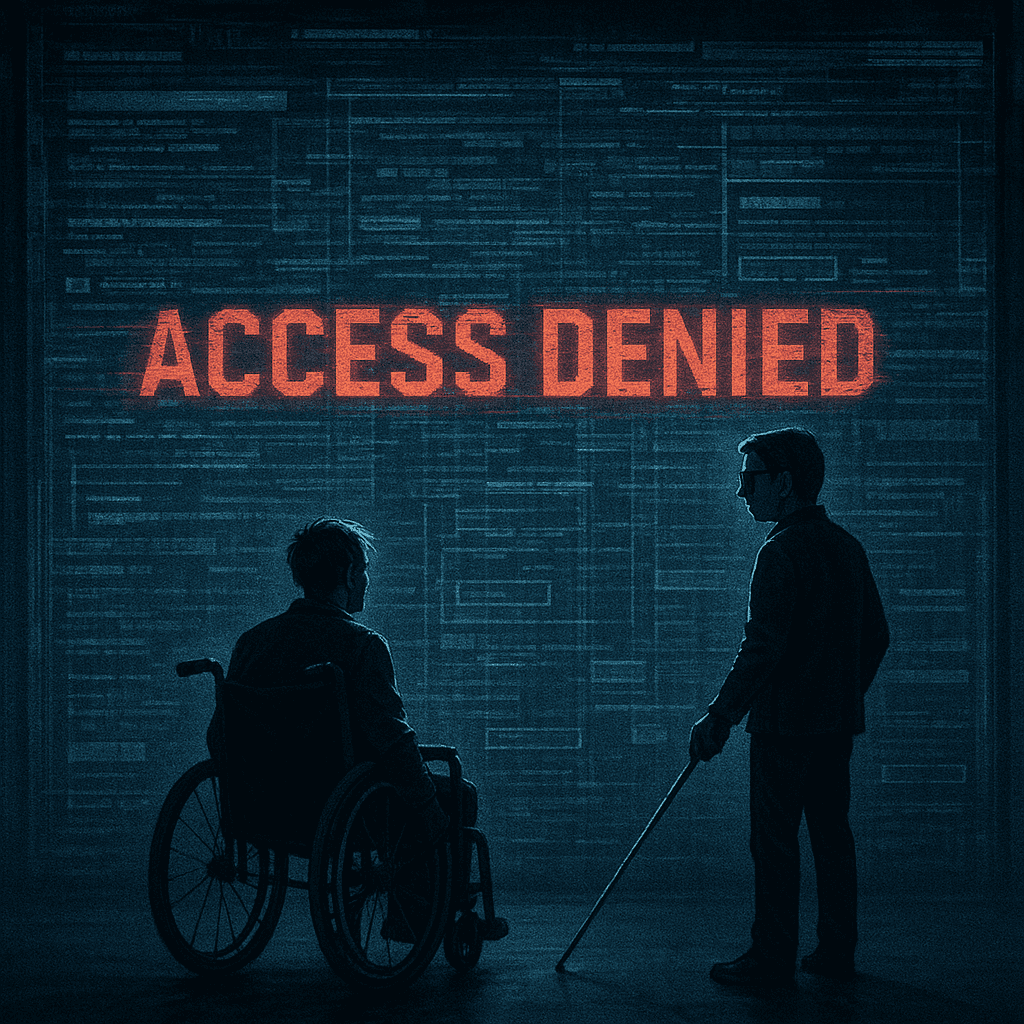
Accessibility means ensuring that everyone, including people with disabilities, can use technology and spaces equally. It’s about removing barriers so that disability doesn’t limit participation in society. This spans the physical world and the digital world - from ramps on sidewalks to captions on videos. Over one billion people (about 16% of the world) live with some form of disability. In developing countries like Cameroon, the proportion is even higher. When we ignore accessibility, we exclude a huge community from education, work, and daily life. True accessibility is not just “nice to have” - it is a basic human right and a foundation of inclusive design.
Why Accessibility Matters for Everyone
Making things accessible isn’t only about helping those with disabilities. When we design for inclusion, everyone benefits. This is often called the “curb cut effect” - named after the small ramps on pavements invented for wheelchair users that ended up helping parents with prams, workers with carts, and many others. In the digital space, the same happens: captions created for deaf users are used by millions who prefer to watch videos on mute, and voice assistants first built for blind users now help people hands-free. In short, accessibility features tend to benefit all users. By building products that anyone can use, we improve user experience across the board and reach a wider audience.
Accessibility is also critical for business and innovation. Many view it as merely a legal box to tick, but it’s so much more - it can drive real growth. An accessible website isn’t just about compliance; it actively boosts your search engine optimisation (SEO) and strengthens your brand’s reputation. It means every potential client or user, regardless of ability, can engage with your content and services. In other words, prioritising accessibility expands your market and makes good business sense. It’s a win-win: we create a fairer society and better products.
Germany’s Example: Championing Accessibility
Germany stands out as a country that treats accessibility as essential, not optional. It has built a strong culture and legal framework to include people with disabilities in all areas of life. Germany’s Disability Equality Act (BGG) was passed back in 2002 to ensure equal access for people with disabilities. Germany kept strengthening its laws over time, updating the BGG to incorporate the EU Web Accessibility Directive, which mandates that all public sector websites and mobile apps be usable by people with disabilities.
Germany didn’t stop at the public sector. It introduced the Barrier-Free Information Technology Ordinance (BITV 2.0) to specify technical standards for accessible websites and apps. This ensures things like proper text alternatives for images, keyboard navigation, sufficient colour contrast, and so on are consistently implemented in government digital services. And now, in 2025, Germany is extending these requirements to many private businesses through its new Accessibility Strengthening Act (BFSG). Thanks to these measures, accessibility is becoming a default expectation in Germany.
Cameroon’s Reality: Gaps and Lessons to Learn
In Cameroon, the importance of accessibility is just starting to get the attention it deserves. In 2022, Cameroon finally ratified the United Nations Convention on the Rights of Persons with Disabilities (CRPD) after years of advocacy campaigning. Cameroon also became one of the first African countries to adopt the African Disability Protocol, aiming to address unique regional challenges.
Today, many Cameroonians with disabilities still find everyday technology and environments unusable. Journalists with impairments in Cameroon have described accessible tech as a “distant myth” because basic tools are lacking. One visually impaired reporter explained that his office had no internet and no screen reader software on the computers, making it nearly impossible for him to do his job. Another journalist who is deaf recounted that events she covers rarely have sign language interpreters or even captions on projectors, leaving her literally out of the conversation.
Cameroon actually has laws that call for accessibility, such as a 2010 law on the protection of persons with disabilities, which mandates access in public buildings. But enforcement is weak, and many buildings, schools, and websites remain full of barriers.
Designing for Everyone, Not Just the Able-Bodied
One of the biggest challenges in technology today is that too often, products are designed by able-bodied people who do not consider the needs of those with disabilities. A recent analysis of the top one million websites found that about 95% of homepages had accessibility errors as of 2025. Common issues include text with low contrast, images without alt text, or forms that can’t be navigated via keyboard.
The solution is straightforward: nothing about us without us. In practice, this means involving users with different abilities at every stage of design, and treating their feedback as essential. As Camsol’s team aptly put it, “Accessibility isn’t a feature, it’s a foundation - and a daily learning process.” Concretely, that involves steps like:
- Testing with real users, not just assuming everything is fine.
- Designing for assistive tech from the start - ensuring a website works with screen readers and can be used with only a keyboard.
- Asking who might be excluded by a design choice - and then changing it.
Camsol’s Commitment: Accessible and Sustainable Tech
Camsol is a tech company with roots in both Cameroon and Germany, and it was founded on the idea that technology can empower people only if it’s accessible to all. Camsol’s unique position - with one foot in Germany and one in Cameroon - allows it to transfer knowledge and standards between the two. German accessibility standards influence how Camsol designs products in Cameroon. At the same time, the company tailors solutions to local contexts, understanding the constraints in Cameroon and innovating around them.
Camsol also shows that inclusive tech can be sustainable and scalable. When a website is built to be accessible, it often ends up more robust and user-friendly for everyone. Features like fast page loading, clear layouts, and text alternatives don’t just help disabled users; they make the site better overall. By delivering high-quality, accessible websites to businesses, Camsol is proving that accessibility and commercial success go hand in hand.
Accessibility as a Shared Duty
Accessibility isn’t an add-on or an afterthought - it’s a shared responsibility we all have to uphold. Whether we are policymakers, business owners, developers, or everyday citizens, we each have a role in making our world inclusive. Most importantly, we must remember that accessibility is about dignity and opportunity. We should no longer tolerate inaccessible design in our public spaces or our digital products.
The future we shape with technology must include everyone, or it’s simply not a future worth building. Embracing accessibility is an act of respect and common sense. It ensures that tech fulfils its promise of improving lives - for all of us, not just some.